
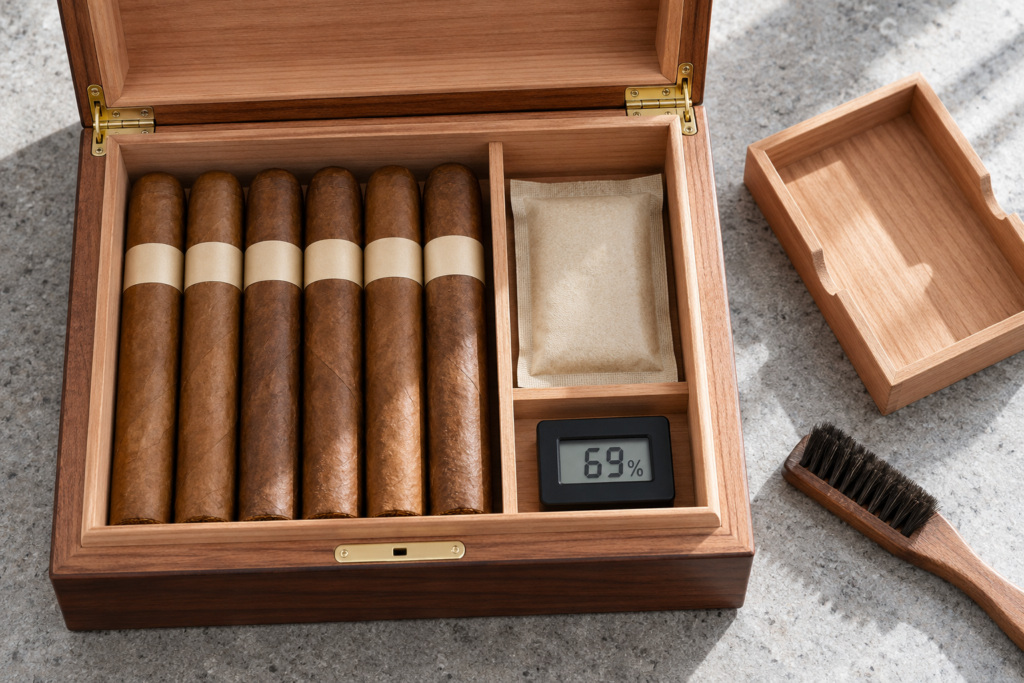
Storage technology presents specialist tobacco retailers with a purchasing question that goes beyond cabinet appearance. Selecting a cigar humidifier requires understanding whether the equipment adds moisture, regulates it in both directions or relies on electronic controls. These differences influence maintenance demands and how effectively a business can manage changing conditions around valuable inventory.
For retailers stocking Cohiba cigars alongside other premium products, the financial exposure extends beyond the wholesale purchase price. Cabinet preparation, replacement consumables and equipment reliability all contribute to the cost of holding stock. Comparing these expenses before purchasing a storage system gives operators a clearer basis for assessing its commercial suitability.
The distinction matters when businesses expand their range or replace existing displays. A larger cabinet introduces additional storage space, but it also requires a reassessment of moisture control, monitoring and the time needed to prepare the installation.
Moisture control systems perform different functions
Not every storage product manages moisture in the same way. Traditional reservoir-based equipment supplies moisture to the surrounding air, while two-way humidity packs are designed to release or absorb moisture as conditions change. This gives the latter a different operating function from a device that only adds water vapour.
Electronic systems introduce another set of purchasing considerations, including power requirements, controls and access to replacement components. Buyers need to examine the specifications of the individual model rather than assume that electronic operation automatically means lower maintenance.
For a retailer, the useful comparison is between complete operating arrangements. Purchase price, consumable costs, servicing and staff involvement should be assessed together.
The choice also needs to reflect the cabinet itself. Equipment intended for a compact enclosure should not be treated as interchangeable with a system designed for a substantially larger display.
New wooden cabinets need preparation time
A newly purchased wooden cigar humidor may need conditioning before stock is introduced. This process, commonly called seasoning, allows the wood to absorb moisture before it becomes part of the storage environment.
Preparation time varies with the method and manufacturer. One established humidity-pack system specifies a 14-day seasoning period, demonstrating why retailers should not assume a new cabinet can immediately receive merchandise.
That lead time has practical consequences for shop refits and inventory deliveries. A business replacing its only storage cabinet needs an alternative arrangement while preparation takes place.
Scheduling installation ahead of a major delivery can therefore be more useful than coordinating both for the same day. Existing stock should also remain in suitable storage while the new enclosure is prepared.
Preparation instructions deserve the same attention as equipment specifications. Shortcuts can undermine the purpose of investing in a better cabinet.
Sensor accuracy changes the diagnosis
An unexpected reading does not automatically establish that the moisture-control equipment has failed. Instrument calibration, cabinet preparation and the introduction of new stock can all affect the interpretation of humidity measurements.
The underlying concept is hygroscopy, the ability of a material to absorb moisture from its surroundings. Wood and tobacco interact with the storage environment, so changes inside an enclosure need to be considered alongside equipment performance.
For staff, this creates a practical sequence: check the measuring instrument, review recent changes and then assess the system. Replacing equipment before investigating these factors can add expense without resolving the cause.
Keeping dated records makes that review easier. A note showing when stock arrived or a cabinet was serviced can provide useful context for a changed reading.
Purchasing specifications should include maintenance
Retail buyers often compare capacity and finish first. Maintenance requirements deserve equal attention because they determine the resources needed after installation.
Supplier questions should cover approved consumables, inspection intervals, replacement parts and warranty conditions. Businesses also need to establish whether routine tasks can be handled by staff or require specialist assistance.
A low initial price may offer limited value if essential components are difficult to replace. Conversely, a more expensive system needs a clear operational benefit to justify the additional investment.
Standardising equipment across several cabinets can simplify purchasing and training, provided the systems suit each enclosure. Consistent procedures also make it easier for staff to cover maintenance responsibilities during absences.
Expansion needs a commissioning plan
Adding storage capacity is a small operational project rather than a furniture purchase. Retailers need to coordinate delivery, preparation, instrument checks and the transfer of stock.
A commissioning plan can allocate responsibility for each step and establish when the cabinet is ready for use. It should also identify how merchandise will be stored if installation or preparation takes longer than expected.
For independent businesses, these measures need not involve complex documentation. A short checklist, clear supplier instructions and an assigned staff member can support a controlled transition.
The commercial benefit is a more informed investment decision: equipment selected for its operating function, introduced on a realistic schedule and supported by maintenance the retailer can consistently deliver.